Dragon Ball Z vs Dragon Ball Z Kai: Differences, Filler Cuts and Which Version to Watch
Dragon Ball Z Kai revisits the Z story with edited pacing and updated presentation. Compare episode counts, filler, voice performances and the right version for your first watch.
QUICK ANSWER
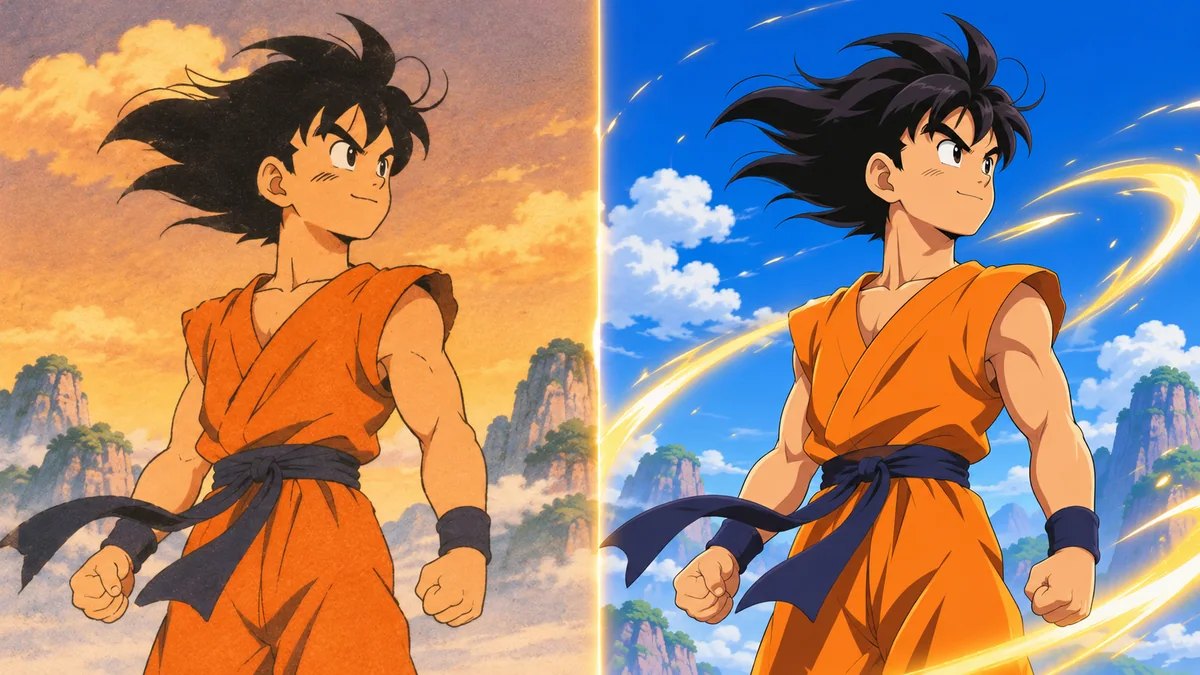
Dragon Ball Z is the original 291-episode television adaptation. Dragon Ball Z Kai is a later recut that aims to follow the manga's main story more closely, with re-edited footage, revised audio and a shorter broadcast run. Counts vary by territory and by whether the later Final Chapters are included: Toei's catalog lists the original Japanese Kai run as 97 episodes. This guide explains what changes, what stays, and which version makes sense for a first viewing.
Source record: Read the original source
The short answer
Choose Dragon Ball Z Kai if you want a more streamlined version of Goku's Z-era story and you are watching for the first time. Choose the original Dragon Ball Z if you want the historical television experience, its full pacing and its familiar presentation. Both tell the same broad core story from the Saiyan arrival through the major Z conflicts; Kai is not a sequel and it does not replace the earlier Dragon Ball series.
The important caveat is edition naming. “Kai” has different counts in Japanese, North American and other releases because the later Final Chapters were packaged and edited differently. Toei's official catalog lists 97 episodes for the original Japanese Kai broadcast through its initial run. Other releases split or combine the material differently. Do not use one streaming platform's season count as a universal episode total.
Episode count: why sources appear to disagree
Toei's official catalog lists Dragon Ball Z at 291 television episodes, broadcast from 1989 to 1996. Its separate catalog entry for Dragon Ball Kai lists 97 episodes for the first Japanese broadcast run, which covered the earlier Z material. Kai later continued with The Final Chapters in a separate run, so 97 alone does not represent every Kai installment available in every market.
English-language listings can number the continuation as a single series, a second part, or a set of seasons, and edits may alter the number. The safest comparison is not “Z is 291, Kai is exactly X everywhere.” It is: the original Z catalog has 291 episodes; Kai is a recut that substantially reduces the original broadcast count; and the complete Kai viewing path includes the later Final Chapters. Check the episode guide on the service or release you actually have.
What Kai changes
Kai was produced by revisiting the existing Z animation and editing the presentation to move more directly through the manga storyline. The aim was to reduce long stretches of material added for the weekly television broadcast while retaining the central character arcs and major battles. It also uses a revised soundtrack and newly recorded dialogue in Japanese, so an episode is not simply an unchanged Z file with a new title card.
The project includes remastered or altered imagery, new opening and ending material, and, depending on language and release, different voice performances and mix choices. Some viewers prefer the crisp rhythm; others find parts of the new image treatment or sound less appealing than the original. Those are legitimate preferences. If you switch versions midway, expect small differences in timing, cuts, score and voice work rather than a perfectly seamless episode-to-episode transition.
Filler is not the same as every slow moment
Dragon Ball Z added anime-original scenes and episodes partly because the television adaptation was catching up to a manga still being published. Kai trims much of that detour material, which is why its pacing usually feels faster. But the original series' slower scenes are not all standalone filler: some are manga-adapted events extended for suspense, reaction or a weekly cliffhanger.
That distinction matters if you want to skip material in Z. A filler list may label whole episodes, but an episode can include a canon scene alongside anime-only material. For a first watch, the simplest route is to choose one version rather than alternate between Z and Kai to chase individual cuts. If you enjoy the original, let it breathe. If you find the waiting and repetition distracting, Kai solves more of that problem in one coherent path.
What both versions preserve
The central Z story remains recognizable in each version: Goku's Saiyan heritage changes the scale of the world, old enemies become uneasy allies, and later battles ask what strength costs. The family and mentor relationships are part of the experience too. Kai's faster rhythm does not turn the series into a different genre or remove the broader Dragon Ball premise.
Some omissions are about television padding rather than missing story arcs. Still, no cut is perfectly neutral. A comedic exchange or quiet reaction can be an anime addition and still be a scene a longtime fan loves. The value of Kai is that a viewer can reach the key events more efficiently; the value of Z is that its complete original broadcast rhythm is itself a piece of anime history.
Which version suits which viewer?
FIRST-TIME VIEWER → Kai is a sensible default if both versions are available and you want the main Z narrative with less repetition. It is especially helpful for a binge where long pauses between plot developments would break your momentum.
COMPLETIONIST OR NOSTALGIA WATCHER → choose Z. The longer adaptation gives you the original broadcast experience, including anime-only scenes, extended confrontations and the sound and performance style many fans grew up with.
VOICE-PERFORMANCE CURIOUS → sample the first episode in the Japanese audio and your preferred English dub. Cast and script choices can vary by version and region. Do not assume the English cast from one edition carries across every Kai or Z release.
Where Dragon Ball fits
If you are new to the franchise, Dragon Ball Z and Kai both start after the original Dragon Ball story. You can begin at Z and understand its opening, but relationships and callbacks have more meaning if you first watch Dragon Ball from episode 1. That earlier series follows Goku as a child and establishes friends, rivalries and the martial-arts foundation.
A compact route is: Dragon Ball → Dragon Ball Z Kai (including Final Chapters) → Dragon Ball Super, with films and specials placed using an official franchise guide. Another valid route is Dragon Ball → Z → Super for viewers who want the original TV history. Do not watch Z and Kai back to back as if they were two sequential seasons; they overlap as alternate adaptations of the same era.
How to confirm the version on a US service
Before starting, inspect the title page rather than relying on a search snippet. Confirm whether the product is labeled Dragon Ball Z, Dragon Ball Z Kai or Kai: The Final Chapters; check how many episodes are displayed; then open the language menu for English and Japanese audio and subtitles. A listing may show a season number that is a platform grouping rather than the Japanese broadcast part.
Availability changes by provider and territory, and some services license only selected pieces of the franchise. The official Toei catalog supports the basic episode-count distinction, while Toei Animation USA gives franchise-level distribution information. A platform's current player is the source for its actual U.S. episode and audio inventory.
Bottom line: one story, two useful viewing experiences
Dragon Ball Z is the complete original television adaptation in its 291-episode Japanese catalog. Dragon Ball Z Kai is the recut route for viewers who want a faster adaptation of the core story, with the later Final Chapters included in the full viewing path. The biggest practical difference is rhythm and version presentation, not a new story that must be watched after Z.
For most first-time viewers I recommend Kai if a complete version is available in their region. I recommend Z to people who want the original broadcast flavor or already know they enjoy the series' slower build. If you're unsure, watch one early episode from each. The version whose timing and voices make you want to see the next one is the right version for you.
Based on Toei Animation official catalogs for Dragon Ball Z and Dragon Ball Kai. This report distinguishes confirmed details from information not established by the original source.
View primary sourceSource date / checked: · Rechecked
Found a factual error? Contact the editorial desk.