Big Three Anime Compared in 2026: One Piece vs Naruto vs Bleach
Compare the Big Three by length, story shape, filler, dubbed viewing, and best starting point, with a practical recommendation for US anime fans.
QUICK ANSWER
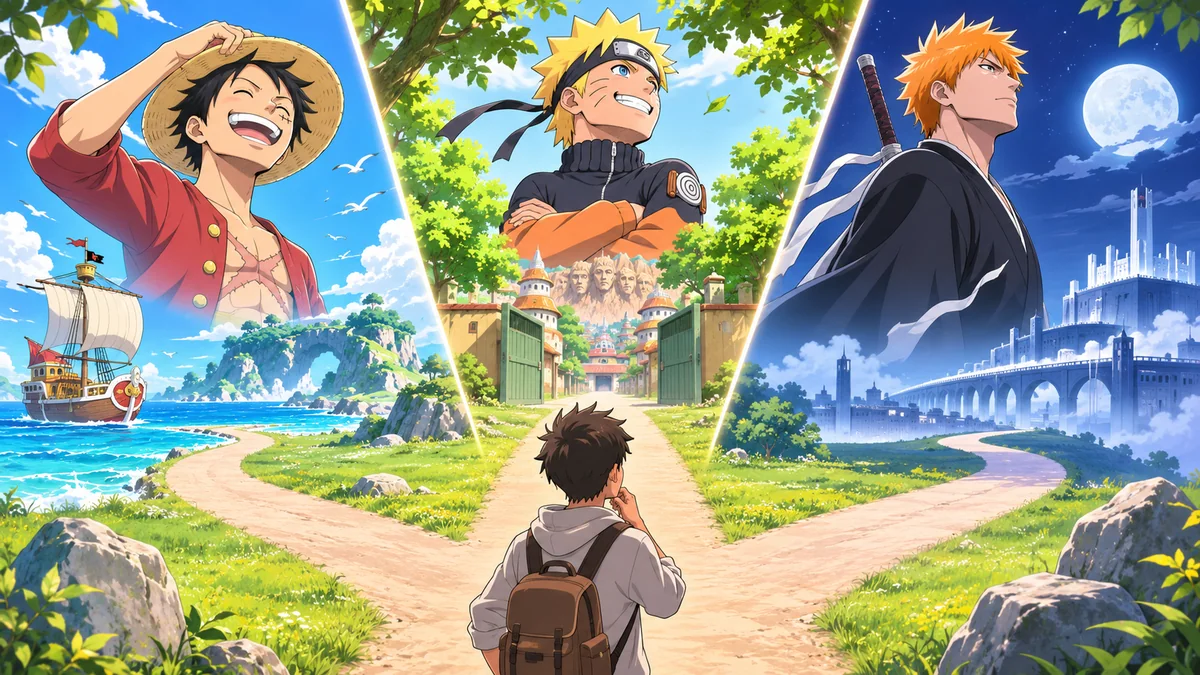
Choose One Piece for a huge ongoing pirate adventure, Naruto for a completed coming-of-age saga with a sequel franchise, or Bleach for supernatural sword action with a finished original TV run and a separate Thousand-Year Blood War continuation. Episode counts and filler classifications use different scopes, so compare the viewing experience rather than treating every franchise total as directly equivalent.
Source record: Read the original source
The quick answer: choose by viewing mood
The Big Three nickname usually means One Piece, Naruto, and Bleach, three Weekly Shonen Jump hits whose anime reached a broad international audience in overlapping eras. They are not a formal award category, and choosing among them is not a quality ranking. The useful question is which kind of long-running story you want to spend time with.
Pick One Piece if the appeal is a crew's open-ended voyage, strange islands, and payoffs that can take hundreds of episodes to arrive. Pick Naruto if you want a more bounded coming-of-age story about belonging, rivalry, and a young ninja growing into a leader. Pick Bleach if you want stylish supernatural battles, a large spirit-world cast, and a more distinct divide between its original television run and later Thousand-Year Blood War adaptation.
What the Big Three label means and does not mean
“Big Three” is fan and industry shorthand for the international prominence of One Piece, Naruto, and Bleach during a shared period of Shonen Jump success. It is not a sales metric with a single official cutoff, a current popularity chart, or a claim that only these three series matter. The phrase describes a cultural era more than a permanent ranking.
That context explains why the shows are often compared even though their premises and release histories differ. One Piece is still publishing new anime episodes on a more limited annual schedule. Naruto's main story has a completed two-series route, followed by Boruto material. Bleach's original anime ended before the manga finale was animated; Thousand-Year Blood War later returned as a separate adaptation. Think of them as three different commitments, not interchangeable 700-episode boxes.
One Piece: the journey is the point
One Piece is the best fit if you enjoy a large ensemble that steadily becomes a found family. Luffy's goal supplies a simple compass, while each new island adds a local conflict, culture, history, or friend. The adventure is designed for long-term accumulation: a detail that seems incidental early on may gain meaning much later. That scale can make the show unusually rewarding if you like remembering names, places, and promises.
The tradeoff is time and pacing. Toei's official Elbaph update noted that the anime had passed 1,150 episodes in 2026, and its announced production plan limits the series to up to about 26 new episodes annually. A filler list can help, but it cannot remove every slow sequence inside manga-adapting episodes. New viewers who want to avoid a weekly catch-up pressure can watch arcs at their own pace or begin with the manga.
Naruto: a more direct growth arc
Naruto is the most straightforward pick if your favorite part of a battle series is watching a young lead earn trust. The original Naruto establishes the village, Team 7, and the protagonist's early motivations; Naruto: Shippuden moves the cast into adulthood and larger conflicts. The combined 720-episode TV story is substantial, but it has a clearer endpoint than an ongoing One Piece watch.
Filler is the main practical question. Naruto's anime contains substantial anime-original material, especially in later portions of Shippuden. A first-time viewer can follow the main manga adaptation while using a careful episode guide for clearly standalone blocks. Keep mixed episodes if a guide flags story material inside them. Boruto is a sequel franchise, not a necessary part of Naruto's original ending, so you can stop after Shippuden and decide later whether you want the next generation.
Bleach: supernatural action with a split history
Bleach suits viewers drawn to sword fights, striking character silhouettes, spirit-world politics, and a rotating ensemble of allies and rivals. The original TV anime has 366 episodes. It tells the first major run of Ichigo's story, but its adaptation history means it did not originally animate the manga's final arc. Thousand-Year Blood War addresses that gap as a separate continuation with its own parts and schedule.
That split can make Bleach easier to plan for than its raw total suggests: the original anime has a well-defined run, followed by a clearly labeled sequel adaptation. It still has filler arcs and mixed episodes, so use an episode-level guide if your goal is a manga-focused route. If you like the original show's style but do not want to decide about every special, watch the main series first and treat films and side projects as optional.
The honest length comparison
Raw episode totals can mislead because the scopes differ. One Piece is an ongoing TV series with more than 1,150 episodes documented by Toei in 2026. Naruto and Shippuden form a 720-episode main saga. Bleach's 366 episodes refer to the original show, while Thousand-Year Blood War is a separate later adaptation. Calling all three “complete” or comparing only their original runs erases important release context.
A rough watch-time estimate can still help: multiply episodes by about 23 minutes, then remember that episodes have different runtimes and some viewers skip openings or recaps. The estimate is a planning tool, not an audited runtime. More important is whether you want to live with one story for months, reach a planned ending, or leave space for a sequel after the first finale. The best first show is the one whose premise you will happily return to tomorrow.
| Series | Core viewing shape | Best fit | Commitment note |
|---|---|---|---|
| One Piece | Ongoing, long-form adventure; 1,150+ episodes documented by Toei in 2026 | Worldbuilding, crew chemistry, slow-burn payoffs | Largest commitment; Toei shifted to a maximum of about 26 new episodes yearly from 2026 |
| Naruto + Shippuden | 720 episodes across the original saga | Coming-of-age, rivalries, mentor and village arcs | Completed main story; filler guides can reduce the first-watch route |
| Bleach original + TYBW | 366 original TV episodes, followed by a separate TYBW adaptation | Stylish supernatural action and ensemble fights | Original run has a clear endpoint; TYBW is a later continuation with its own release schedule |
Filler, canon, and what is worth skipping
Filler labels are editorial classifications, not labels printed on every episode by the original creators. Some guides count only fully anime-original stories; others count recaps, crossover episodes, mixed manga-and-original scenes, or anime-canon side stories. That is why two reputable lists can report different filler totals. For One Piece, the 2026 production change may affect how much future padding is needed, but it does not retroactively turn older episodes into manga chapters.
For a first watch, skip only clearly standalone material if your priority is reaching the manga plot. Keep mixed episodes unless the guide tells you exactly which section is skippable. If you enjoy character downtime, some anime-original arcs are pleasant extras rather than wastes of time. A strict “canon only” sprint is a preference, not the one correct way to watch a series that many fans enjoy for its anime-specific performances and soundtrack.
A practical first-watch route for US viewers
Start the first three to five episodes of each show before committing. One Piece quickly reveals whether Luffy's tone and adventure style work for you. Naruto introduces its central team and emotional stakes early. Bleach establishes Ichigo's supernatural premise and visual mood in its opening stretch. A small sample is more predictive than choosing from reputation or debating which fandom has the strongest favorite arc.
US streaming rights move between services and can be split by season, dub, or episode range. Check the platform listing in your own region before planning a marathon, and verify whether English audio is present for the specific season you want. A service that hosts a new season does not necessarily carry every early episode. Manga access is another route: VIZ publishes English editions of all three series, which can be a more time-efficient way to catch up.
Our recommendation in one sentence
If you want the biggest ongoing adventure, start One Piece; if you want a complete emotional growth saga, start Naruto; if you want supernatural sword action with a clearly separated original run and sequel, start Bleach. None is the universally correct entry point, and none requires you to watch every filler arc to understand its main story.
A friendly order for someone curious about all three is to sample Naruto first for a quick sense of classic shonen character drama, then Bleach for a darker supernatural shift, and then begin One Piece when you are ready for the longest commitment. That order is only a scheduling suggestion. The series are independent, so follow the one whose characters, soundtrack, or first conflict has already caught your attention.
Based on VIZ Shonen Jump franchise pages and official anime/streaming announcements, checked November 20, 2026. This report distinguishes confirmed details from information not established by the original source.
View primary sourceSource date / checked: · Rechecked
Found a factual error? Contact the editorial desk.