Manhwa vs. Webtoon vs. Manga: The Publishing Differences Explained
Manhwa refers to Korean comics, manga to Japanese comics, while webtoon often describes a vertical-scroll digital format. Learn how editions, reading direction and platforms differ.
QUICK ANSWER
Manga commonly identifies Japanese comics, manhwa Korean comics, and webtoon a digital scrolling presentation that can be used by creators from multiple countries. Origin, format and platform overlap but are not interchangeable.
Source record: Read the original source
Three words describing different aspects of comics
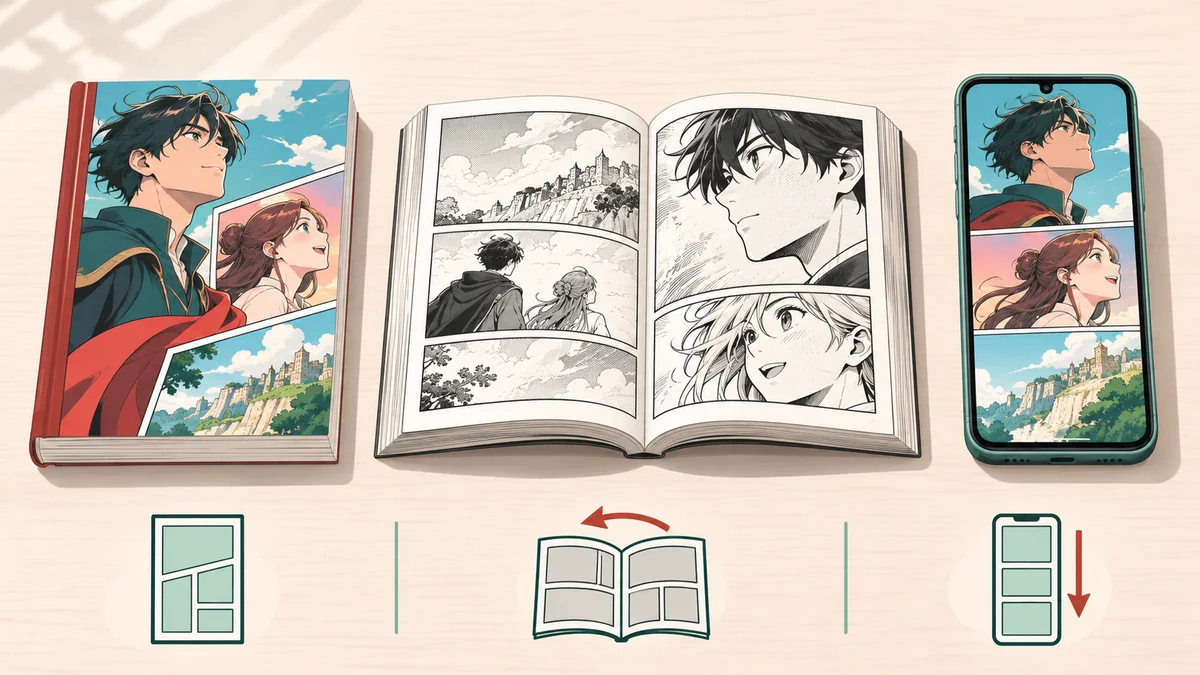
Manga, manhwa and webtoon often appear side by side in English bookstore searches, but the terms do not all describe the same kind of thing. Manga commonly refers to Japanese comics, manhwa to Korean comics, and webtoon to a digitally presented comic often read by scrolling down a phone screen. The first two terms usually communicate cultural or national publishing traditions. The third frequently communicates presentation and distribution format, which can be used across countries and genres.
This distinction explains why a Korean comic can also be a webtoon, while a Japanese work can be adapted into a vertical-scrolling webcomic. Readers sometimes use webtoon as shorthand for Korean comics because South Korean digital platforms popularized the style, but publisher announcements show that creators and rights holders from elsewhere use it too. WEBTOON Entertainment has announced partnerships bringing Japanese franchises and Western comics into vertical-scroll editions.
The terms also do not specify a story's genre. There are manga about romance, sports and workplace life as well as action; Korean manhwa can cover court drama, comedy or slice of life; webtoon describes a delivery form used for many subjects. Recognizing the axes of origin, presentation and story type is a better starting point than treating all three words as rival genres.
| Term | Usually describes | Format can include |
|---|---|---|
| Manga | Japanese comics or the Japanese comics tradition. | Print books, page-based digital chapters and adaptations into other formats. |
| Manhwa | Korean comics or the Korean comics tradition. | Print books and digital comics; the term alone does not mean vertical scrolling. |
| Webtoon | A digital comics format/platform, often designed for vertical scrolling. | Works from Korea and other regions; platform and origin are not interchangeable. |
What VIZ means when it explains manga
VIZ Media's official FAQ describes manga as a Japanese form of comics that has characteristic storytelling traditions. It notes that printed Japanese manga are usually read from right to left, meaning an English edition may open in a direction unfamiliar to readers raised on Western comic books. That reading order affects panel sequencing, speech balloons and how an illustrated spread communicates motion. It is a material design characteristic, not a decorative convention.
Many manga editions use black-and-white interiors, although full-color pages and digital variants also exist. A reader should not assume every manga is monochrome, however, or that monochrome art proves a comic originated in Japan. The publisher, original language, credited creators and edition information provide a more reliable basis for identifying origin. Printed trim sizes and binding vary too, especially for larger omnibuses or collector editions.
A US reader buying a manga paperback should verify the publisher, ISBN and stated reading direction. VIZ's English series pages make it possible to distinguish a physical volume from digital serialized chapter access. The title on a cover alone may be shared by an anime adaptation, a light novel and a manga edition, each with its own release dates and rights.
How the word manhwa works in practice
Manhwa is widely used in English to describe comics originating from Korea. Korean comics have appeared in print and digital settings, and not every comic associated with the country was made specifically for continuous vertical scrolling. Modern international readers often encounter Korean stories through licensed webcomic apps, which means their first experience may be a phone-oriented full-color format. That common encounter should not be mistaken for a requirement built into the word manhwa.
Examples on official English WEBTOON include Eleceed, credited to Jeho Son and ZHENA, and The Greatest Estate Developer, based on a work by BK_Moon with an illustrated adaptation. Their presentation is associated with a licensed webcomic platform, while their underlying credits connect them with Korean creative production. The Greatest Estate Developer also illustrates how a prose original can become a comic, without the comic being the same literary object as the novel.
For a collector, manhwa's origin does not promise one uniform reading direction or English publishing arrangement. A particular Korean comic may appear in vertical episodes, later in printed books, or in multiple licensed language editions. Check the actual published format rather than assume its Korean origin settles whether its pages turn like Western books or a Japanese paperback.
What makes a vertically scrolling webtoon different
WEBTOON Entertainment describes modern webcomics as mobile-native, vertically scrolling storytelling. Instead of always moving from panel to panel on a fixed printed page, a reader can scroll down a sequence whose spacing and screen-length reveals are designed around a phone. The empty space between scenes, tall compositions and timing of visual surprises can become part of the storytelling. That is a format design decision, not a guarantee of a particular art style.
Vertical-scroll presentation can also make an existing work feel different when adapted from another medium. A page composed for print can use two-page spreads or side-by-side action, while a scrolling adaptation may distribute the information over a longer sequence. Neither approach is inherently superior; each gives creators different control over rhythm and attention. Comparing them fairly requires looking at the particular authorized edition.
The WEBTOON name is also a company and platform, written in capitals in many official documents. The broader word webtoon is used for a type of digital comic. A work does not need to have originated with that company to use a scrolling design. In 2026, WEBTOON itself announced projects adapting iconic Japanese properties into the platform's scroll format, showing the difference between origin and distribution.
Publishing models: serialized episodes versus collected volumes
Japanese manga can run as individual magazine or online chapters before being collected into numbered volumes. Korean webcomic platforms also distribute stories as episodes and may later license physical editions. The core publishing question is therefore not which word is on the cover but whether the reader is looking at a new installment, a completed digital series or an assembled book. These events can have separate timetables and access conditions.
VIZ's One Piece and Kagurabachi records offer examples of weekly digital chapters appearing on schedules distinct from English book releases. WEBTOON's English Omniscient Reader listing shows a series on hiatus with an official return notice, while Eleceed has active numbered entries. The former is a publication-status question, and the latter a continuing-series access question. Both are webcomic examples, but neither automatically proves anything about a future paperback or Japanese-style chapter release.
Publishers also use different numbering conventions. Episode 100 in a scrolling comic is not necessarily equivalent in length or plot coverage to Chapter 100 of a manga or Volume 10 of a collected edition. A volume often packages multiple installments, and translations can follow the original market on a different schedule. Comparing the actual contents is safer than equating numbers across formats.
Where English-language US readers can start
A reader interested in Japanese manga can begin with a licensed publisher such as VIZ and check whether the title is offered as a paperback, digital purchase or Shonen Jump chapter serial. English WEBTOON carries authorized episodes of Korean-origin titles such as Eleceed, Lookism and The Remarried Empress. The platform may provide free first episodes, ongoing chapters, app-only early access or other reading rules depending on the title and its current status.
These options answer different needs. Someone building a shelf may prefer a printed volume with an ISBN; someone who wants the newest translated installment may prefer an official chapter app; someone following a mobile-first Korean fantasy may want the original scrolling presentation. A licensing platform can offer multiple kinds of products, so its brand name alone does not establish free access to all its titles or permanent ownership of a digital chapter.
For US readers, geography matters as well. A Korean-language publisher may host episodes that do not have an English translation on the same date, and an American storefront may carry a collected edition after a digital adaptation has progressed. The safest path is to verify the exact language, publisher and territory, then check the available format and age rating before reading or buying.
Common misconceptions worth avoiding
One misconception is that manga always means animated Japanese entertainment. Anime refers to animation, while manga is the comic format; an anime adaptation of a manga may have a different release schedule and may not cover the whole story. Another is that manhwa always means full-color vertical scrolling. Although that presentation is prominent in modern licensed Korean digital comics, the term describes Korean comics more broadly.
A third misconception is that everything on WEBTOON was created in Korea. The company hosts different kinds of work, and its creator rules cover self-published CANVAS comics. It has also announced collaborations involving Japanese and Western intellectual property. These examples show why a platform's storefront is not a simple proxy for the nationality of every title inside it. Cultural origin, creator identity and format are distinct facts that should not be collapsed.
Finally, the presence of a comic online does not establish that it is licensed or freely reusable. For a reader, official distributor pages help identify authorized English access and terms. For a publication, those same records support proper attribution without reproducing copyrighted chapters or promotional illustrations. Accurate terminology is most useful when it leads to accurate sourcing and reasonable expectations about editions.
A practical checklist for choosing a series
First identify the work's original publishing tradition and credited creators: Japanese manga, Korean manhwa or a comic from another source. Second, decide which format you want: a printed book, a digital page-based edition or a vertical-scroll series. Third, check whether the work is ongoing, completed or paused on the specific English service you intend to use. That status may differ from an original-language edition or a related adaptation.
Next, inspect the publisher's age rating, chapter or episode order and price model. A free preview does not mean the entire archive can be read forever without charge, and a paid app chapter is not necessarily equivalent to owning a digital book. If a title becomes available in print later, its ISBN and book-number sequence provide the relevant identifiers for buying or borrowing. These steps make an unfamiliar comics market easier to navigate without reducing it to stereotypes.
The useful distinction is not a competition between Japanese and Korean storytelling. Manga and manhwa point principally toward comics traditions and origins, while webtoon describes an influential digital publishing and reading format. Because those categories overlap, a Korean manhwa can also be a webtoon, and a Japanese franchise can gain a vertical-scroll edition. Recording the specific edition and platform gives readers more reliable information than assuming a single word defines everything.
Based on VIZ, Korea Manhwa Contents Agency, WEBTOON Entertainment and Korean Cultural Centre sources checked November 20, 2026. This report distinguishes confirmed details from information not established by the original source.
View primary sourceSource date / checked: · Rechecked
Found a factual error? Contact the editorial desk.