Solo Leveling Season 1 Episode 2 Review: If I Had One More Chance
Source-based review of Solo Leveling Season 1 Episode 2, “If I Had One More Chance,” examining its story choices, stakes, and place in Jinwoo's progression.
Editor-in-Chief: Satya Prasad
Spoiler notice: this article discusses released installment events described by the sources.
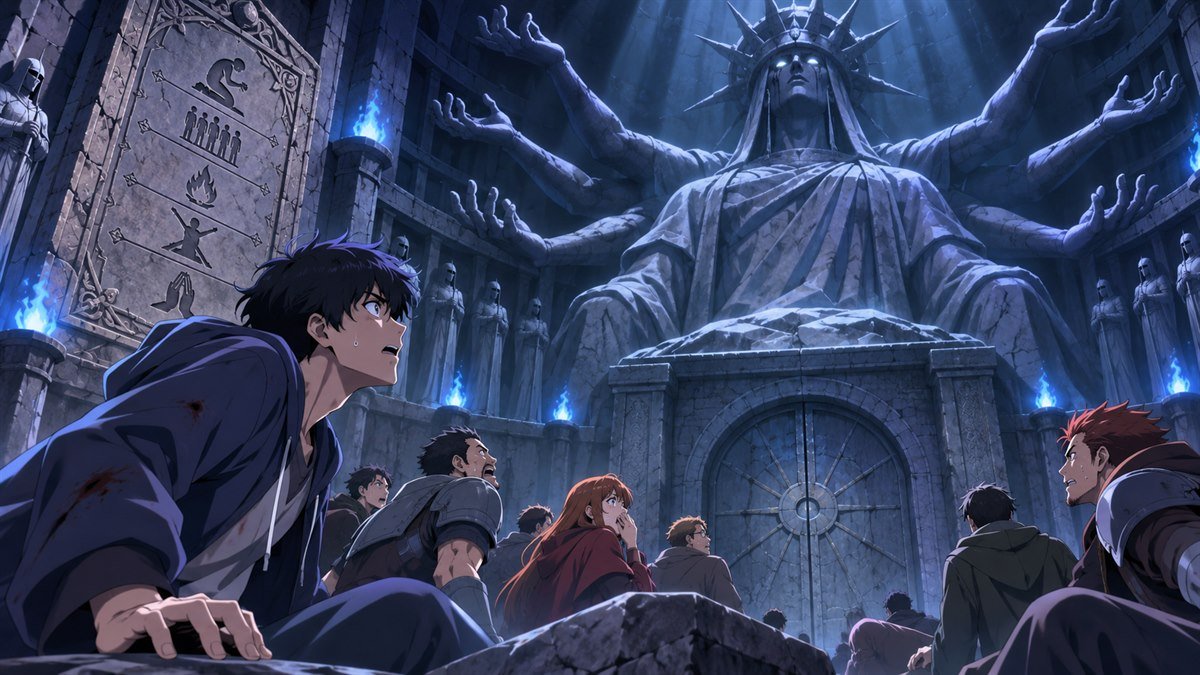
The strongest idea is that a party's confidence can collapse faster than its formal rank can help it. The temple's rules make the double dungeon feel like a different kind of danger: one where misreading the room matters as much as being outmatched.
The episode's dramatic job
The documented plot turns on a clear event. A low-level dungeon seems cleared until a hidden route leads Jinwoo's party into a temple governed by commandments and lethal statues. The hidden temple turns a routine raid into a moral and procedural trap. That gives the installment a concrete dramatic job. It sets the scale of risk before asking whether Jinwoo can meet it, and connects this episode's event to the season's larger progression. The shift matters because Solo Leveling's power fantasy depends on an earlier sense of vulnerability: a victory or new ability only registers when the story has established what it can change. This episode asks the season to take that starting condition seriously.
Jinwoo's choice and its cost
Jinwoo's defining choice is shown through a specific decision. Jinwoo and the group must decide how to respond when survival depends on reading rules they do not understand. A stronger hunter can survive situations that once seemed impossible, but survival alone does not explain what he values. This decision places a personal aim or obligation beside the visible challenge, and that pairing gives his growth a human scale. It also leaves room for friction: other hunters may see rank, strength, or usefulness where Jinwoo sees a particular person or promise. The episode works best when that difference changes what he is willing to do.
The rules behind the conflict
The episode's rules become concrete at one pressure point. The dungeon's commandments imply that the hunters' usual tools and rankings cannot explain every threat. The System and the hunter institutions do not offer the same kind of power. One gives Jinwoo a private route to change; the other sorts people publicly and shapes the risks they can take. That divide is useful story material because it distributes status, money, and safety rather than merely decorating a battle with statistics. The episode tests a specific part of that arrangement and leaves open whether Jinwoo can use an advantage without being trapped by the narrow measures that once defined him.
Structure and payoff
The episode record gives this sequence a clear direction. The episode makes endurance, attention, and cooperation more important than combat strength. That movement works when new information changes a character's options instead of serving only as a teaser for a larger enemy. The installment has to balance its immediate event with the season's onward motion, and it gives the turn a connection to survival, trust, or responsibility. That is a stronger basis for suspense than an unexplained promise that the next opponent will be more powerful. In a progression story, visible escalation can become predictable unless each step changes the meaning of the journey.
What works, and what stays thin
There is a clear strength here. The strongest idea is that a party's confidence can collapse faster than its formal rank can help it. That idea makes Jinwoo's changing position matter beyond a score or rank. There is also a limitation. The sudden shift from a familiar raid to an unknown ritual is effective, though the rules are deliberately opaque and can feel like a puzzle delivered at speed. It matters because power escalation needs a second source of drama—relationships, social rules, and consequences that cannot be settled by another upgrade. This episode points toward that wider potential, even where some supporting people or mechanics remain lightly developed. The next challenge is to let the installment's strongest idea produce consequences rather than repeat it as a familiar beat.
How it moves the season forward
The episode leaves the season in a specific position. The temple's rules make the double dungeon feel like a different kind of danger: one where misreading the room matters as much as being outmatched. That ending creates a meaningful next question instead of simply resetting the story. Its contribution is not measured only by whether Jinwoo wins; it is measured by what his route forward asks him to risk, understand, or protect. Season 1 has its own larger arc, but each installment still needs a distinct turn inside it. This review is source-based and evaluates documented story events and their narrative function; it does not claim a shot-by-shot account or firsthand viewing.
Research sources and release verification
Research checked . The publisher establishes release facts; independent sources inform the analysis above.
Only the publisher or authorized streaming service controls access, release times and language options.
Open the official installment listing