Solo Leveling Chapter 5 Review: Jinwoo Looks for a Pattern
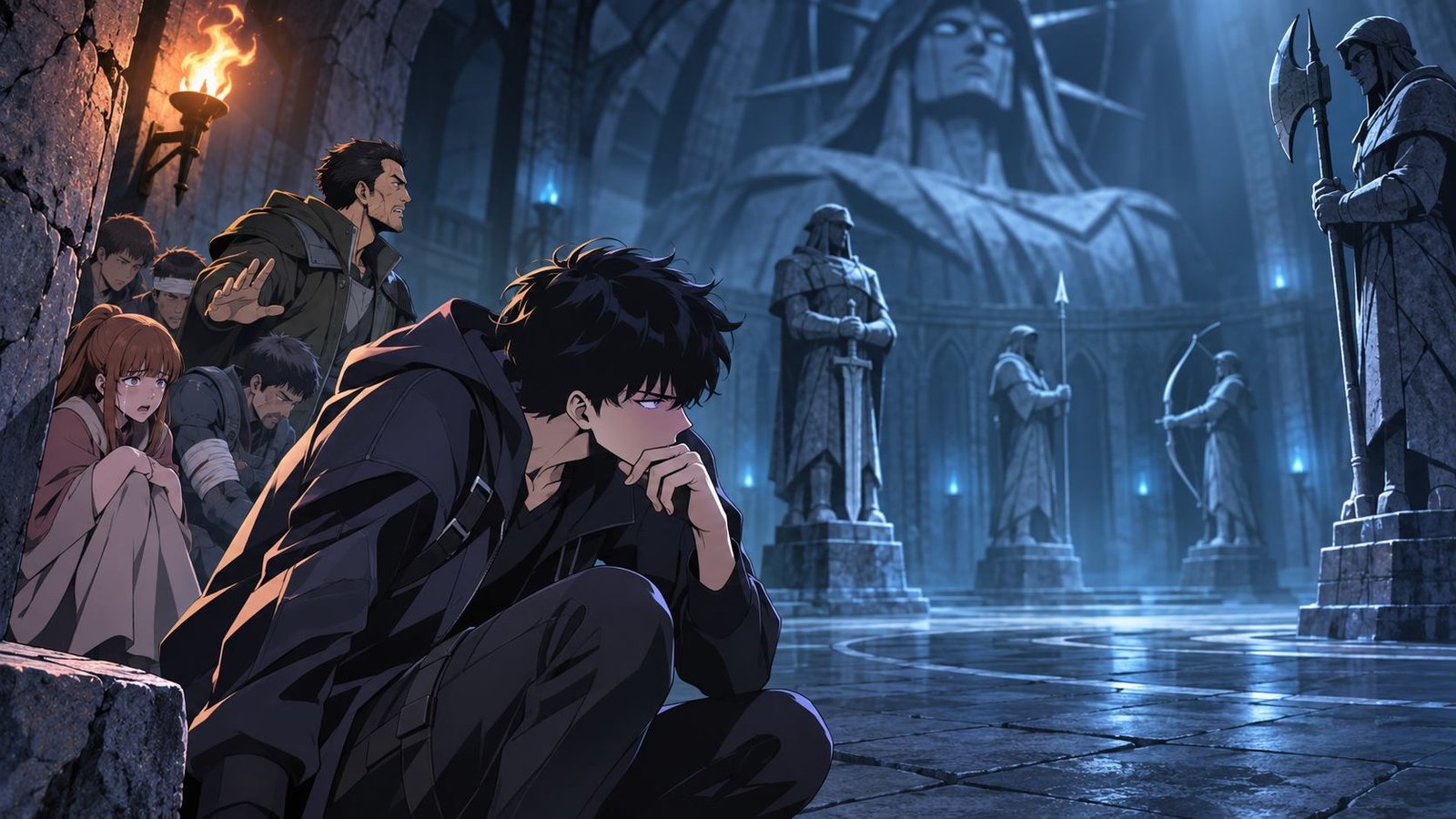
The survivors begin to understand that the statues do not attack at random. Jinwoo’s suspicion that the chamber follows rules shifts the crisis from helplessness toward a dangerous form of problem-solving.
Editor-in-Chief: Satya Prasad
Spoiler notice: this article discusses released installment events described by the sources.
This chapter’s central pleasure is watching a low-ranked hunter make observation useful to a group that has far more raw power than he does. The rule-based premise gives Jinwoo a path into leadership, but the room keeps every deduction provisional. That balance preserves suspense better than an easy answer would.
The statues are dangerous because they seem selective
The party’s first problem is not simply that the statues can kill them; it is that the statues do not appear to attack continuously. If the room’s guardians were ordinary monsters, the hunters could think in terms of weapons, distance or escape. Their pauses suggest a condition, which leaves the group trying to infer what counts as a violation.
Jinwoo’s observation that the attacks seem governed by rules is the chapter’s most important shift. It is a hypothesis, not a solution, but it gives the survivors a way to act besides panic. The dungeon begins to resemble a system with hidden inputs and outputs, while the hunters themselves are the people forced to test it.
Joohee’s fear changes the team’s capacity
Joohee’s inability to heal effectively is a painful reversal of what her rank promises. The team has a B-rank healer, yet the circumstances are too frightening for that ability to function as expected. The contrast shows the limits of treating hunters as job titles: skill matters, but a person’s state of mind matters too.
Jinwoo does not dismiss her fear or tell her to simply be brave. Her reaction is presented as an understandable response to what she has seen. That makes the group’s dilemma more human, but it also raises the stakes for his deductions. A correct interpretation could save them; a wrong one could leave the injured without the support they need.
Experience and attention are different kinds of strength
Song can estimate the threat in combat terms, but the statues are not offering a conventional fight. Jinwoo’s lower status means he has spent more time calculating what he can survive, and that habit becomes useful in a chamber where strength alone is no answer. The story gives him competence without pretending his body has changed.
This is an effective early use of the underdog premise. Jinwoo is not valuable because everyone secretly misunderstands his true power; he is valuable because he is paying attention to evidence other hunters might miss. The difference matters. It lets the chapter build a reason for the party to listen to him before the series grants him any extraordinary means.
A puzzle can be more frightening than a monster
The chapter’s rule-based threat creates a distinct kind of suspense: every movement could be an experiment, but the cost of a failed test is severe. The room does not hand over a clue in a safe environment. It makes the characters reason while injured, frightened and uncertain whether they have enough time to think.
That design is familiar in survival fiction, yet it fits Solo Leveling’s broader interest in systems. Here the rules are not a convenient interface for Jinwoo; they are a hostile environment that he must interpret. The difference keeps the scene uneasy and allows a small insight to feel consequential without making it a triumphant victory.
Jinwoo begins to lead without rank
As the others look for an explanation, Jinwoo’s careful reading starts to earn attention. Leadership here is situational rather than formal: he has no authority over the party and no strength to enforce a plan. The group has to decide whether a theory from its weakest member is worth following.
That makes the chapter an early test of trust. The survivors are not suddenly friends, and the chamber has given them reasons to blame one another. Jinwoo’s credibility comes from a willingness to think through what he sees, not from speeches. The story’s change in hierarchy is small but clear: the person once treated as a liability may know how to keep them alive.
Research sources and release verification
Research checked . The publisher establishes release facts; independent sources inform the analysis above.
Only the publisher or authorized streaming service controls access, release times and language options.
Open the official installment listing