Solo Leveling Chapter 8 Review: The Altar Makes Survival Collective
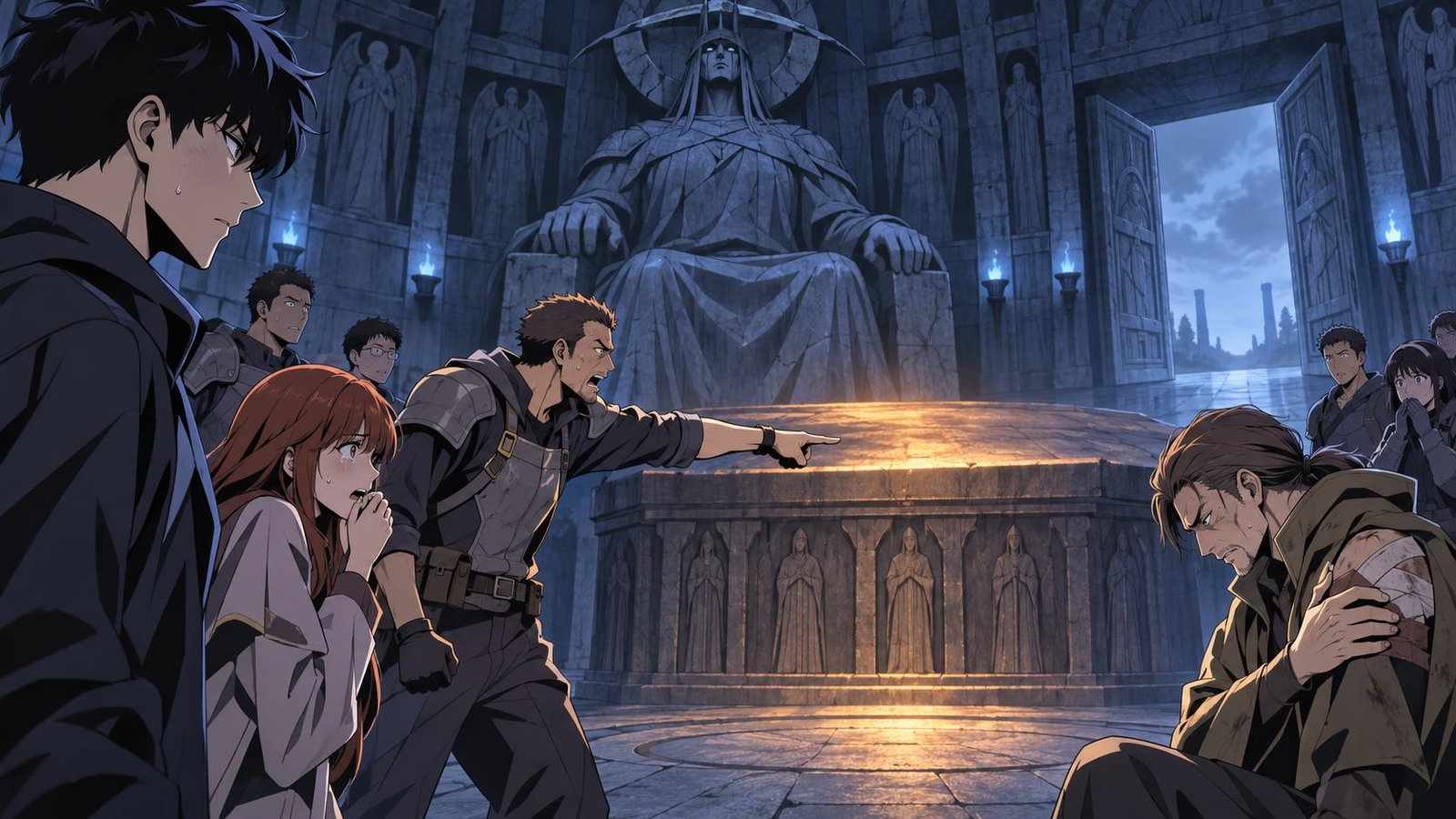
After the earlier trials have taken a heavy toll, the remaining hunters reach an altar that appears to begin the final commandment. The group must decide how to survive together even as blame and fear pull it apart.
Editor-in-Chief: Satya Prasad
Spoiler notice: this article discusses released installment events described by the sources.
Chapter 8 makes cooperation feel both necessary and unstable. The altar gives the survivors a possible safe zone, but no clear explanation of what it requires. Jinwoo and Song are injured, and the group has already begun searching for someone to blame. The chapter’s power lies in showing how quickly survival becomes a moral negotiation.
The survivors arrive diminished
The altar sequence begins with a party that has been reduced in number and capability. Only a small group remains, and Song and Jinwoo are badly hurt. The room’s first trials have already made survival expensive, so the next commandment arrives not as a clean puzzle but as a demand placed on exhausted people.
This state of depletion matters to the chapter’s tension. A choice that might seem straightforward to a healthy group becomes dangerous when someone must be carried, when the leader has lost an arm, and when the person making deductions is injured. The altar is not a reset point; it is a new stage built on the cost of what came before.
The altar creates a possible safe zone
The appearance of an altar changes the survivors’ immediate question. They are no longer only trying to avoid the statues; they have to decide what staying on the raised platform means. Its connection to the commandment about proving faith suggests that it may be a place of safety, but the rules are still incomplete.
Jinwoo’s proposal to be carried there is a practical inference under pressure. It treats the altar as something to test, but the test may leave people exposed if he is wrong. The chapter uses the uncertainty well: a possible refuge is not comforting when nobody can explain why it should work, and every delay gives the statues more time to close in.
Blame lands on Song
Kim Sangshik’s anger gives the group’s fear a target. Song led them into the hidden room, so blaming him offers a simple story for the deaths: someone chose the wrong path, and someone should pay for it. The accusation is emotionally plausible even though the original vote and the collective decision make responsibility more complicated.
Song’s willingness to accept blame reveals his sense of leadership. He does not evade the fact that he brought the party in, but his response does not prove that he alone caused the disaster. The chapter allows responsibility and culpability to sit beside each other. A leader can own the outcome without being able to control the system that produced it.
A desperate group negotiates a sacrifice
The debate about who should remain on the altar turns the last commandment into a moral problem. Some survivors read it as requiring a sacrifice, and Jinwoo’s injured condition makes him appear expendable to people trying to find an answer quickly. The text leaves room for a dangerous misunderstanding, which is exactly what the temple seems designed to exploit.
This is the arc’s most human conflict so far. The hunters are not debating an abstract rule in safety; they are imagining that another person may have to die. Song and Jinwoo must think about who can carry Joohee, while the others must choose between a possible exit and the group’s remaining capacity. Fear does not erase moral judgment; it distorts it.
The open gate offers a new temptation
The final image of an available door shifts the room’s pressure from physical danger to decision. The hunters have been told to prove faith, and a visible exit offers an alternative to waiting for an uncertain answer. The chapter’s cliffhanger makes freedom look immediate while leaving the reader unsure whether the temple intends it to be trusted.
The setup is effective because it connects the room’s rules to behavior rather than trivia. The test may depend on whether the survivors obey an unseen promise or chase an obvious escape. That reading is an inference from the chapter’s commandment and altar framing, not a guaranteed interpretation yet, which keeps the next installment necessary.
Research sources and release verification
Research checked . The publisher establishes release facts; independent sources inform the analysis above.
Only the publisher or authorized streaming service controls access, release times and language options.
Open the official installment listing